As Ostia is the gate to Rome, Italy, San Antonio is the gate to Santiago, Chile. A devastating earthquake in 1985 leveled eighty percent of the city, and a massive quake struck again in 2010. They are just now getting back on their feet.
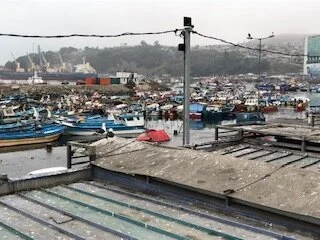
Fishing fleet
They are the major port for seaborne freight. We were berthed across a waterway from a Cosco container ship and it was fascinating watching them. The crane operators here are twice as fast as the operators were in Rio. They pluck up a container, move it so fast it sways, sets it down precisely on the bed of a semi, and is back up there to pluck another before the truck has time to drive away. The ship was bellied up to a pier with four cranes, and all four were in operation. The other operators were just as swift. A steady stream of trucks moved past the cranes being loaded or unloaded.
This presents problems for pedestrians. The problems are minimized by buses who hauled us from the Queen Victoria’s gangway, a distance of about 200 yards, to the passenger terminal. Shucks, we could walk the 200 yards if it weren’t for the 16-wheel behemoths cruising by. A loaded container semi still out-inertias a bus, but at least in a bus, you have a fighting chance.
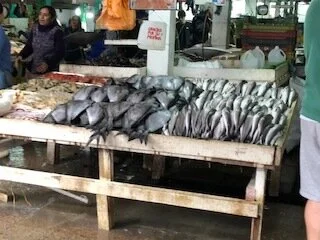
Fish market
An explanatory brochure offered by the ship says that they are just getting started with tourism. Pedestrians from the cruise ships stroll a promenade along the waterfront with dozens of small booths and stalls where locals sell clothes, shoes, socks, and the usual made-in-China mementos. Often the emporium is simply a blanket on the ground, like the local First Nations artisans lining the inner harbor in Victoria.
One guy, though, had a definitely local artisan endeavor. He carved swordfish bills. He had a couple dozen swordfish beaks lying there. Some he drove into the ground as sort of fencing to delineate his booth. Were Bill still alive, he would have bought one or two bills and from them would fashion marlinspikes, the pointy tools seamen use when they’re splicing rope and line.
At the far end of the promenade is the fish market. Most of it, somewhat like the Pike Place Market in Seattle, is open but under a roof. Beyond the fish market, independent fishermen sell their wares in booths like the others’. If every person in San Antonio ate a whole fish every day, they still couldn’t eat all the fish offered. Some of that has got to be several days old. And a tub of clams was half open.
There are a lot of birds around, but they’re all Kelp Gulls. I thought maybe I would at last score a passerine (a perching bird as opposed to water birds), but what I thought was a bird singing turned out to be a local woodcarver who made flutes, or whistles, to duplicate birdsong.
What I sought most of all was a drug store. A simple farmacía. An angel in the form of an 80-year-old lady from the ship who has been here before pointed out the local grocery store. There are no clues on the outside to tell you what it is. Inside, it’s much like a Fred Meyer, with clothing and other stuff in addition to food.
And right next door was a pharmacy.