We are sailing northward up the Chilean coast with the Atacama, the world’s driest desert, off to starboard. I am attaching a picture of it. Yes, it is a fogbank.
There are three easy ways to make a desert. One is to raise a rainshadow, high mountains that block clouds. God does that with mountain-building. Another way is to put your desert so far inland that clouds lose their moisture before they reach it. Like the Gobi, for instance. A third way is to situate your desert in the correct latitude. Very moist air rises off the equator and takes off to the north and south. As it rises it cools and dumps its moisture. But it hits the ceiling and has to descend, getting warmer. Now not only has it lost a lot of moisture, it is getting warmer, and warming air can hold its moisture. Thus you have the Sahara, for example.
Deserts that are really good at being deserts use more than one method. The Gobi, for instance, is way the heck and gone in the interior, and the Himalayas to the south block even more moisture.
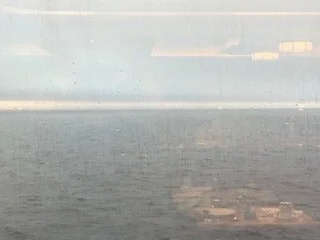
The Atacama desert from the west looking east. It’s a fog bank.
The Atacama, however, thought up a fourth way. It lies right on the Pacific shore, but it gets none of the ocean’s moisture. The ocean current concerned here is the Humboldt Current, which drags really cold water up from Antarctica and the Southern Ocean. Air currents moving over it don’t pick up much moisture. And what they do pick up is mostly fog. See photo. Meanwhile to the east, the Andes rose to wild altitudes and blocked out the prevailing easterlies, leaving the Atacama low and dry.
There are parts of the Atacama that have not seen rain in centuries. Most of it is totally devoid of any vegetation whatever. Even the Karoo desert of Africa has a few specialized plants, including a few that can draw needed moisture from fog.
And the Australian interior has been a desert for so very long, a variety of scrub plants have learned how to invade it and make a living there. And where you have plants, eventually animals will come along to exploit them. Insects, of course, are animals; you just don’t think of them that way because they’re not warm and furry like a proper animal ought to be. But they are pioneers at making do in inhospitable climates.
Was the Atacama always so sere a wasteland? No. The Andes are relatively young as mountains go, and until they worked their special rainshadow magic, the Atacama could receive a little leftover moisture from Patagonia.
Incidentally, paleoclimates is a fascinating study. It determined what dinosaurs lived where, where forests grew and where they didn’t, and once upon a time there were lots and lots of deserts. To get you started, google Chris Scotese. He made some of the first and best climate maps of the earth’s surface millions of years ago.
But that was then; this is now. And to our right, the Atacama is a fogbank.