
The question arises, “What happens when the weather is really putrid but you’re calling at a port?”
The answer is, nothing.
We arrived this morning on schedule at Puerto Montt (Montt was a local revolutionary hero) and dropped anchor. The land is quite flat and the water too shallow for us to belly up to the pier. The wind was seriously picking up. The first tender went out, tried to dock ashore, and was wallowing too much for rickety old people to disembark. It came back. The captain canceled the call completely.
By the time we gathered the tenders, hung them up, and put back out to sea, the wind waves were really pounding the town’s seawall and breaking over the top.
The girls who organize the entertainment hastily put together a plan B. One of the options was to join the naturalist, Jeff Clarke, out on deck 9 forward to look for weird birds. Sure. I’ll do that. The wind was so strong that I eventually came back inside; God had totally rearranged my hairstyle and blew my bun over my left ear; I got cold; and I couldn’t hold the binoculars still in the wind.
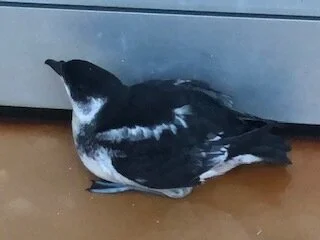
Cape Petrel
Even so, I scored. Earlier as we were anchoring, two storm petrels came by. My first storm petrels ever, and a new family for me. Then when we threw in the towel and left, there was a Peruvian pelican blocking our way. It’s similar to brown pelicans but different. I have no idea if the Queen Victoria ran over it, but we didn’t veer.
I showed Mr. Clarke the photo of the petrel I found on my deck when we were at the Pio XI glacier. Apparently five or six of them got confused by the ship’s lights and landed on our balconies. They need to paddle across the water for a few yards to get airborne, and on a balcony deck, they couldn’t. Every cruise ship is supposed to have a bird person aboard who will send confused seabirds back over the side.
This is a true story: Loons and grebes also have to paddle along the water surface to get airborne, and on one occasion at Joshua Tree the light was exactly wrong; the road looked like a stream and half a dozen grebes landed, unable to take off again. So what you do is hold the grebe by its fluffy butt, run very fast, and throw it. The launch gets it airborne and away it goes to Salton Sea or someplace.
But there was this loon…Loons have long, sharp beaks capable of doing serious damage. We held it by the butt, ran, flung it—and it nose-dived into the dirt. Faster, into the wind. Splat. So I stood in the back of the pickup truck as Bill drove, and I held the loon out to the side. Bill was going almost thirty-five mph when the loon finally lifted off my hands. So here we are taking up most of the road, the truck and the loon flying alongside it, apparently in no mood to go anywhere else.
Which wouldn’t have mattered except this motorcyclist was coming from the other direction and he very nearly went into the ditch rubbernecking—the loon, the truck, the broad standing in the bed behind the cab…. Oh, and did I mention I was eight months pregnant at the time?